

Occupational Therapy in Kitchener, Waterloo & Cambridge
The goal is not just to feel better. It is to function better in everyday life.
A CARESPACE occupational therapist looks at how injury, illness, pain, fatigue, cognition or other challenges are affecting the things you need and want to do. Treatment is practical and personalized, with a focus on helping you return to work, manage daily activities, build independence and function with greater confidence.
Open 7 days a week. Weekdays 8am–8pm, weekends 8am–6pm. No referral needed.
Choose Your Occupational Therapist
Or call (519) 208-2273 – a real person answers.
People across Kitchener, Waterloo and Cambridge come to CARESPACE for occupational therapy.
Why Choose a CARESPACE Occupational Therapist

Choose Your CARESPACE Occupational Therapist
Simply choose the best occupational therapist near you to get started and book your first appointment.
Occupational therapy is a regulated health profession in Ontario. Only practitioners registered with the College of Occupational Therapists of Ontario can use the title “occupational therapist” or “OT,” giving you clear standards for education, professional conduct and accountability.
Registered Occupational Therapists Regulated in Ontario
Every occupational therapist at CARESPACE is registered with the College of Occupational Therapists of Ontario. Your OT is accountable to provincial standards of practice and focuses on helping you improve function, independence and participation in the activities that matter to you.
One-on-One Care Built Around Your Goals
Occupational therapy starts with what you need or want to be able to do. Your therapist works directly with you to identify the barriers getting in the way and develop practical strategies for work, school, self-care, household tasks, recovery and everyday life. Treatment may include functional retraining, activity modification, cognitive strategies, ergonomics, adaptive equipment or changes to your environment.
Open 8am–8pm Weekdays and 8am–6pm Weekends
CARESPACE clinics across Kitchener, Waterloo and Cambridge are open seven days a week, including evenings and weekends. Appointments can be scheduled around work, school and family responsibilities.
Occupational Therapy Coordinated With Your CARESPACE Team
Function can be affected by more than one thing. If physical limitations are slowing your progress, your occupational therapist can coordinate with a CARESPACE physiotherapist or kinesiologist. If stress, anxiety or other mental health concerns are affecting your routines or ability to participate, counselling or psychotherapy can be added to your plan. One team can address the different barriers keeping you from doing the things that matter.
Find an Occupational Therapist Near You

Live-answer Reception
Please call us at (519) 208-2273 to talk with our live-answer Reception Team who will be happy to book, reschedule appointments or answer any of your questions, or book online now.
Open 7-days a week!
Monday–Friday: 8 AM–8 PM
Saturday–Sunday: 8 AM–6 PM
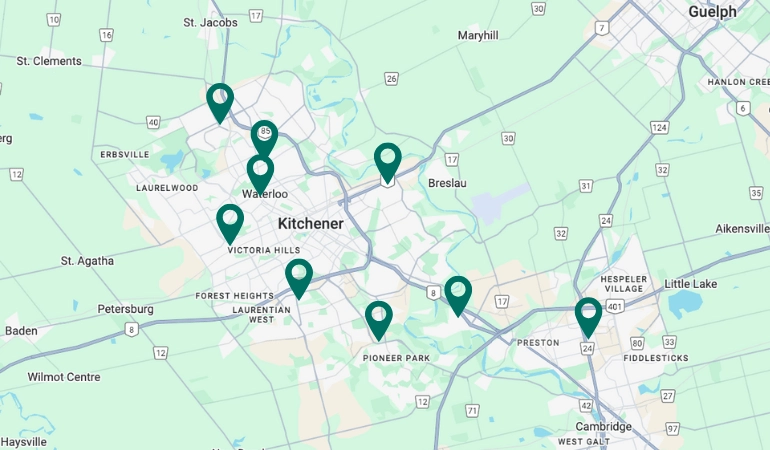
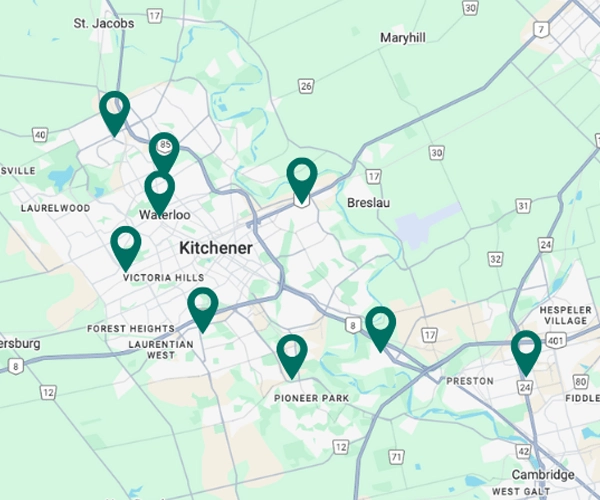
Kitchener Occupational Therapy Clinics
CARESPACE has five clinics in Kitchener offering occupational therapy, with appointments seven days a week.
1373 Victoria Street North, #4A, Kitchener, ON N2B 3R6
720 Westmount Rd E, Unit 9, Kitchener, ON N2E 2M6
851 Fischer-Hallman Rd, Unit 201, Kitchener, ON N2M 5N8
4293 King Street East, Unit 6, Kitchener, ON N2P 2E9
535 Manitou Drive, Unit 104, Kitchener, ON N2P 1M7
Waterloo Occupational Therapy Clinics
CARESPACE has three clinics in Waterloo offering occupational therapy, including Uptown and the Weber Street corridor providing convenience anywhere in the city.
270 Weber St N, Waterloo, ON N2J 3H6
564 Weber Street North #12, Waterloo, ON N2L 5C6
75 King St S, #28B, Waterloo, ON N2J 1P2
Cambridge Occupational Therapy Clinics
CARESPACE offers occupational therapy in Cambridge at our Hespeler Road clinic, open seven days a week. Our Deer Ridge location sits on the border of Kitchener and Cambridge providing convenient access to the communities of Preston and Blair.
529 Hespeler Road, Unit 1, Cambridge, ON N1R 6J2
4293 King Street East, Unit 6, Kitchener, ON N2P 2E9
Kitchener Occupational Therapists
No data was found
Waterloo Occupational Therapists
No data was found
Cambridge Occupational Therapists
No data was found
Prefer to talk to someone? Our live answer reception team is happy to help. Please call us at (519) 208-2273.
What Happens at Your First Occupational Therapy Appointment
Your first visit is a comprehensive assessment focused on understanding what you need to do, what is getting in the way, and what would make everyday life easier or more independent.
1. A Detailed Conversation About Your Daily Life
Your occupational therapist starts by learning about your health history, current challenges, routines, responsibilities and goals. That may include work, school, self-care, household tasks, parenting, recreation or other activities that are important to you.
2. A Functional Assessment
Your OT looks at how you are actually functioning, not just at a diagnosis. Depending on your needs, they may observe you performing certain tasks or assess areas such as strength, coordination, movement, memory, attention, problem-solving or emotional function. Standardized assessments may also be used when appropriate.
3. Identifying What Is Getting in the Way
Your occupational therapist helps determine whether the main barriers are physical, cognitive, environmental, emotional or a combination of factors. They will explain how those barriers are affecting the activities you want or need to do.
4. Practical Strategies Begin
Occupational therapy is designed to be practical. Depending on your goals, your OT may begin working with you on activity modification, pacing, cognitive strategies, ergonomics, adaptive equipment, environmental changes or specific skills needed for work, school or daily life.
5. A Personalized Plan
You and your occupational therapist set clear goals and build a treatment plan around them. Some concerns may only require one or two visits, while recovery from a more complex injury or condition may take longer. Your OT will explain what they recommend, how progress will be measured and what you can work on between appointments.
Why Would Someone See an Occupational Therapist?
People see an occupational therapist when an injury, illness, disability or other health challenge is making everyday activities harder. That may include returning to work or school, managing fatigue, improving memory or concentration, using your hands more effectively, adapting after an injury, or becoming more independent with self-care and household tasks.
Occupational therapy is especially useful when the problem is not simply pain, but what the problem is stopping you from doing. Your OT looks at the person, the task and the environment to find practical ways to improve function and make daily life more manageable.
Is It Better to See an Occupational Therapist or a Physiotherapist?
Neither is better in general; they focus on different parts of recovery. Physiotherapy primarily addresses movement, strength, mobility, pain and physical rehabilitation. Occupational therapy focuses on helping you perform the activities that are important in your everyday life.
Choose a physiotherapist when your main concern is physical recovery, such as rebuilding strength, restoring movement or rehabilitating an injury. Choose an occupational therapist when you are struggling with work, self-care, household tasks, cognition, fatigue, hand function or adapting your activities or environment.
At CARESPACE, you can see both when needed. Your physiotherapist can work on the physical capacity to perform a task, while your occupational therapist helps you translate that progress into better function at home, work, school and everyday life.
Can an Occupational Therapist Help With a Concussion?
Yes. Occupational therapists can help manage the functional effects of concussion, especially when symptoms such as fatigue, headaches, difficulty concentrating, memory problems or sensitivity to light and noise are interfering with work, school or everyday routines.
Treatment may include pacing and energy-management strategies, cognitive techniques, gradual return-to-work or return-to-school planning, activity modification and workplace or academic accommodations. Ontario’s concussion guidelines recommend a gradual return to meaningful activity and support compensatory cognitive strategies when persistent symptoms are affecting employment.
An occupational therapist does not diagnose or medically clear a concussion. Diagnosis and final clearance for return to activities that require medical clearance should come from a physician or nurse practitioner, while your OT can help build and progress the functional return plan.
What Is Occupational Therapy?
Occupational therapy is a regulated health profession that helps people participate more fully and independently in the activities that matter in everyday life. An occupational therapist looks at what you need or want to do, what is making it difficult, and what changes could help you function more safely and effectively.
That may mean rebuilding a skill, finding a different way to complete a task, using adaptive equipment, changing your environment, or developing strategies for physical, cognitive or emotional challenges.
What Does “Occupation” Mean in Occupational Therapy?
In occupational therapy, “occupation” does not just mean your job. It refers to the everyday activities that give structure and meaning to your life.
That can include dressing, cooking, driving, working, studying, parenting, exercising, managing your home, participating in hobbies, or getting through a normal day with greater independence. The goal is not simply to treat a diagnosis. It is to help you do the things that diagnosis is interfering with.
Approaches Your Occupational Therapist May Use
Your OT may use functional retraining to practise everyday tasks, pacing and energy-conservation strategies for fatigue, cognitive strategies for memory and attention, ergonomic changes for work or home, adaptive equipment to make tasks easier, environmental modifications to improve safety, and gradual return-to-work or return-to-school planning.
Treatment is based on your goals and the barriers affecting you, so two people with the same diagnosis may receive very different occupational therapy plans.
What Does OT Reg. (Ont.) Mean?
Occupational therapy is regulated in Ontario by the College of Occupational Therapists of Ontario. “Occupational Therapist” is a protected title, and only practitioners registered with the College may use it or the designation OT Reg. (Ont.).
To practise in Ontario, occupational therapists must meet the College’s education and registration requirements, including an approved occupational therapy degree or equivalent education and at least 1,000 hours of supervised fieldwork or clinical practicum. Once registered, they are accountable to provincial standards for competence, consent, ethics, record keeping and professional conduct.
Every occupational therapist practising at CARESPACE is registered with the College of Occupational Therapists of Ontario.
What the Research Says About Occupational Therapy
Occupational therapy has a broad evidence base because treatment varies considerably depending on the condition and the activity being affected. The strongest evidence generally supports task-focused rehabilitation that helps people regain independence and participate more fully in everyday activities.
Stroke and Neurological Rehabilitation
A major area of evidence. A 2025 systematic review and meta-analysis found that occupational therapy after stroke improved upper-limb function and the ability to perform activities of daily living, with the certainty of evidence rated moderate. Earlier systematic reviews have also found benefits when occupational therapy specifically targets everyday activities such as dressing, eating and personal care.
Hand, Wrist and Forearm Conditions
A 2024 systematic review and meta-analysis of 12 studies involving 1,429 people found that occupational therapy interventions improved hand and upper-limb function, occupational performance and pain. Interventions included exercise, education, assistive devices, splinting and activity-based rehabilitation for conditions such as arthritis, carpal tunnel syndrome and hand or wrist injuries. Evidence certainty ranged from low to moderate depending on the outcome.
Concussion, Brain Injury and Return to Work
Occupational therapy can play an important role when cognitive, physical or emotional symptoms interfere with returning to work and everyday routines. A systematic review of return-to-work interventions following traumatic brain injury found moderate-level evidence supporting multidisciplinary, individualized approaches that address cognition, mental health, job demands and vocational rehabilitation.
Independence in Daily Activities
Research also supports occupational therapy for people who are having difficulty managing everyday activities independently. A systematic review of community-dwelling older adults found particularly strong benefits from home-based interventions for people already experiencing difficulty with activities of daily living, reinforcing the importance of addressing both the person’s abilities and the environment in which tasks are performed.
Does OHIP Cover Occupational Therapy in Ontario?
Sometimes, depending on where you receive care. Occupational therapy provided in settings such as hospitals and rehabilitation centres can be publicly funded, and some people may qualify for publicly funded occupational therapy through home and community care. Private occupational therapy at CARESPACE is not covered by OHIP.
Occupational therapy is included in some extended health benefit plans, although coverage varies. You do not need a physician referral to book with a CARESPACE occupational therapist, but your insurer may require specific documentation for reimbursement. You pay at your appointment and receive an itemized receipt to submit to your benefits provider.
Occupational Therapy FAQ
Do I need a referral to see an occupational therapist?
No. You can book directly with a CARESPACE occupational therapist without a physician referral. Some insurance plans may have their own requirements for reimbursement, so it is worth checking your benefits if you plan to submit the cost.
What can an occupational therapist help with?
Occupational therapists help when an injury, illness, disability or other health challenge is making everyday activities difficult. That can include returning to work or school, managing fatigue, improving memory and concentration, using your hands more effectively, adapting your home or workplace, and becoming more independent with daily tasks.
Does occupational therapy only help with work?
No. In occupational therapy, “occupation” means any meaningful activity you need or want to do, not just paid employment. Occupational therapists can help with self-care, household tasks, school, parenting, driving, recreation, hobbies and other everyday activities, as well as returning to work.
What happens during an occupational therapy session?
Your occupational therapist starts with your goals and the activities you are struggling with. Depending on your needs, treatment may include practising specific tasks, cognitive strategies, pacing and energy conservation, ergonomics, adaptive equipment, environmental changes, or planning a gradual return to work or school.
Can occupational therapy help after a concussion?
Yes. Occupational therapists can help when concussion symptoms such as fatigue, headaches, difficulty concentrating, memory problems or sensitivity to light and noise are affecting everyday life. Treatment may include pacing, cognitive strategies, activity modification and a gradual return-to-work or return-to-school plan.
How many occupational therapy appointments will I need?
It depends on your goals and the complexity of the problem. Some people only need a few appointments to learn strategies or make practical changes, while recovery from a more significant injury or condition may require ongoing treatment. Your OT will explain what they recommend after your assessment.
Can I see an occupational therapist and a physiotherapist at the same time?
Yes. Occupational therapy and physiotherapy often complement each other. A physiotherapist may focus on strength, movement and physical rehabilitation, while an occupational therapist helps you apply those improvements to work, self-care and everyday activities. At CARESPACE, they can coordinate your treatment as part of the same care plan.
Book an Occupational Therapist in Kitchener, Waterloo or Cambridge
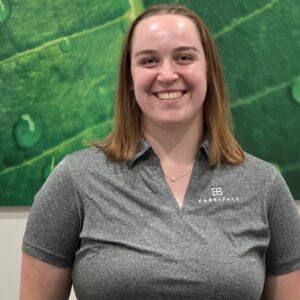
Choose your practitioner and your clinic, and book online in under a minute. Open seven days a week, weekdays 8am–8pm and weekends 8am–6pm. No referral needed, and you will get an insurance receipt at your appointment.
Choose Your Occupational Therapist
or call (519) 208-2273 and speak to our reception team.
Occupational Therapy Articles
Explore more expert tips and insights on how occupational therapy can support independence, recovery, daily function, and a return to the activities that matter most. See all occupational therapy articles.