
Massage Therapy in Kitchener, Waterloo & Cambridge
Pain and tension are often connected to more than one area of the body.
A CARESPACE Registered Massage Therapist looks at how your muscles, joints and movement patterns are contributing to how you feel. Treatment is hands-on and tailored to your needs, with one RMT, one private room, and your full appointment focused on you.
Open 7 days a week. Weekdays 8am–8pm, weekends 8am–6pm. No referral needed.
Or call (519) 208-2273 – a real person answers.
People across Kitchener, Waterloo and Cambridge come to CARESPACE for massage therapy.
Trusted by Clients Across Waterloo Region
Why Choose a CARESPACE Massage Therapist

Choose Your CARESPACE Massage Therapist
Simply choose the best RMT near you to get started and book your first appointment.
Massage therapy is a regulated health profession in Ontario. Registered Massage Therapists must meet provincial education, examination and professional standards before they can practise and use the RMT title.
Registered Massage Therapists Regulated in Ontario
Every massage therapist at CARESPACE is a Registered Massage Therapist regulated by the College of Massage Therapists of Ontario. RMTs complete recognized massage therapy education and must pass both written and practical certification examinations before becoming registered to practise in Ontario.
A Full Appointment, One-on-One, in a Private Room
Your massage therapist stays with you for your full appointment. Treatment takes place one-on-one in a private room, with the pressure, techniques and areas treated adjusted to your needs, comfort and goals.
Open 8am–8pm Weekdays and 8am–6pm Weekends
CARESPACE clinics across Kitchener, Waterloo and Cambridge are open seven days a week, including evenings and weekends. You can book massage therapy around work, school and family schedules rather than having to rearrange your day.
Massage Therapy Coordinated With Physiotherapy, Chiropractic and Kinesiology
If muscle tension or pain is part of a larger movement, injury or rehabilitation problem, your massage therapist can coordinate your care with a CARESPACE physiotherapist, chiropractor, kinesiologist or other practitioner. Your team can work from the same assessment information and build a more complete plan instead of treating each part of the problem separately.
Find a Massage Therapist Near You

Live-answer Reception
Please call us at (519) 208-2273 to talk with our live-answer Reception Team who will be happy to book, reschedule appointments or answer any of your questions, or book online now.
Open 7-days a week!
Monday–Friday: 8 AM–8 PM
Saturday–Sunday: 8 AM–6 PM
Kitchener Massage Therapy Clinics
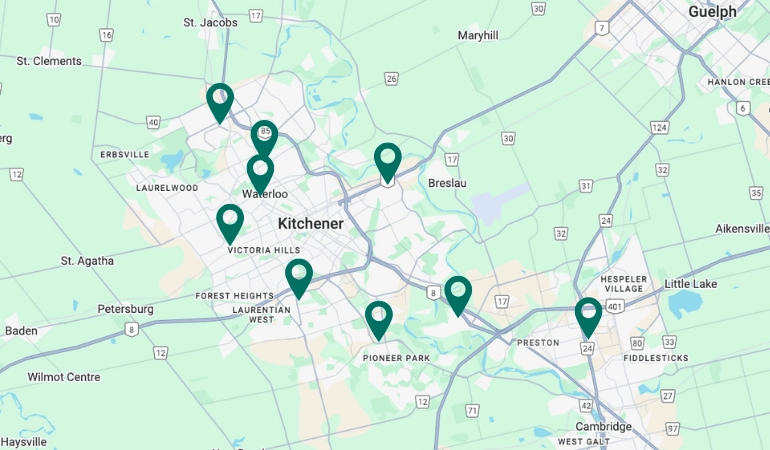
CARESPACE has five clinics in Kitchener offering massage therapy, with appointments seven days a week.
1373 Victoria Street North, #4A, Kitchener, ON N2B 3R6
720 Westmount Rd E, Unit 9, Kitchener, ON N2E 2M6
851 Fischer-Hallman Rd, Unit 201, Kitchener, ON N2M 5N8
4293 King Street East, Unit 6, Kitchener, ON N2P 2E9
1225 Homer Watson Boulevard, Unit 104, Kitchener, ON N2C 0E5
Waterloo Massage Therapy Clinics
CARESPACE has three clinics in Waterloo offering massage therapy, including Uptown and the Weber Street corridor providing convenience anywhere in the city.
270 Weber St N, Waterloo, ON N2J 3H6
564 Weber Street North #12, Waterloo, ON N2L 5C6
75 King St S, #28B, Waterloo, ON N2J 1P2
Cambridge Massage Therapy Clinics
CARESPACE offers massage therapy in Cambridge at our Hespeler Road clinic, open seven days a week. Our Deer Ridge location sits on the border of Kitchener and Cambridge providing convenient access to the communities of Preston and Blair.
529 Hespeler Road, Unit 1, Cambridge, ON N1R 6J2
4293 King Street East, Unit 6, Kitchener, ON N2P 2E9
Kitchener Massage Therapists

Waterloo Massage Therapists


Cambridge Massage Therapists
No data was found
Prefer to talk to someone? Our live answer reception team is happy to help. Please call us at (519) 208-2273.
What Happens at Your First Massage Therapy Appointment
Your first appointment gives your Registered Massage Therapist time to understand what is bothering you, assess how you are moving, and begin treatment that is appropriate for your goals.
1. A Relevant Health History
Your RMT starts by asking about the problem that brought you in, along with relevant injuries, medical conditions, medications, work demands, exercise and other factors that may affect treatment. The goal is to understand what you are experiencing and make sure massage therapy is safe and appropriate for you.
2. A Focused Physical Assessment
Depending on your concern, your RMT may assess posture, movement, range of motion and the muscles or joints involved. They may also use specific orthopedic tests or hands-on assessment to better understand where tension, restriction or pain is coming from.
3. A Clear Treatment Plan and Your Consent
Before treatment begins, your massage therapist explains what they found, what they recommend treating and which techniques they plan to use. You can ask questions, request changes or decline any part of the assessment or treatment. Your consent and comfort guide the entire appointment.
4. Hands-On Treatment
Treatment usually begins during your first visit. Your RMT may use techniques such as Swedish massage, deeper soft-tissue work, trigger point therapy, myofascial techniques or other approaches based on your needs. Pressure is adjusted to your comfort, and only the areas being treated are uncovered while appropriate draping is maintained.
5. A Plan for What Comes Next
At the end of your appointment, your RMT explains how you responded to treatment and what they recommend next. That may include another appointment, changes to treatment frequency, simple movement or self-care strategies, or coordination with another CARESPACE practitioner if your condition would benefit from additional care.
Why Would Someone See a Massage Therapist?
People see a Registered Massage Therapist for muscle pain, tension and stiffness, recovery from injury or exercise, headaches, neck and back discomfort, and problems caused by repetitive work or prolonged sitting. Massage therapy can also help improve mobility, reduce muscular tension and support recovery when your body feels tight, sore or overworked.
You do not need to be injured to benefit from massage therapy. Many people book regular treatment to manage recurring tension, support an active lifestyle, reduce the physical effects of stress, or address small problems before they begin interfering with work, sleep, exercise or everyday movement.
Is It Better to See a Massage Therapist or a Physiotherapist?
Neither is better in general; they are designed to do different things. Massage therapy focuses primarily on muscles, soft tissue, tension, pain and mobility using hands-on treatment. Physiotherapy places more emphasis on assessing movement, strength and function and often uses exercise and rehabilitation alongside hands-on care.
Choose a Registered Massage Therapist if muscle tension, soreness, stiffness or soft-tissue discomfort is your main concern, or if you want hands-on treatment to support recovery and movement. Choose a physiotherapist if you are recovering from an injury or surgery, have significant weakness or loss of function, or need a structured rehabilitation program.
At CARESPACE, you do not have to choose one or the other when both could help. Your massage therapist and physiotherapist can coordinate your treatment so hands-on care and rehabilitation work toward the same goals.
Can Massage Therapy Help With Headaches?
Massage therapy may help with tension-type headaches and some headaches associated with neck pain, particularly when muscle tension in the neck, shoulders, upper back or jaw is contributing. Treatment may focus on reducing soft-tissue tension, improving mobility and addressing trigger points that can refer pain into the head.
Clinical guidelines recommend considering massage as part of care for chronic tension-type headaches, and a 2024 systematic review found that myofascial techniques may reduce pain and disability in tension-type and cervicogenic headaches, although the quality of evidence varies.
Massage therapy should not be presented as a treatment for every type of headache. Migraine evidence is less certain, and sudden, severe or unusual headaches should be medically assessed before treatment.
What Is Massage Therapy?
Massage therapy is a regulated health profession that uses hands-on assessment and treatment of the muscles, connective tissues and joints to relieve pain, improve movement and support physical function. Registered Massage Therapists also assess how muscle tension, injury, repetitive activity, posture and movement may be contributing to your symptoms.
Treatment is tailored to the individual. Depending on what your RMT finds, your massage may be focused on a specific painful or restricted area, several connected areas, recovery from activity or injury, or more general muscle tension and relaxation.
Techniques Your Massage Therapist May Use
Your RMT chooses techniques based on your assessment, goals and comfort. Treatment may include Swedish massage using rhythmic strokes and kneading; deeper soft-tissue techniques for areas of persistent tension; trigger point therapy for sensitive areas within muscle; myofascial techniques for restrictions in connective tissue; and stretching or joint mobilization to improve movement.
Some RMTs also use techniques such as lymphatic drainage, pregnancy massage or sports massage when appropriate. Pressure does not need to be painful to be effective, and your therapist should adjust treatment throughout the appointment based on your response and preferences.
What Does RMT Mean in Ontario?
RMT stands for Registered Massage Therapist. Massage therapy is regulated in Ontario by the College of Massage Therapists of Ontario (CMTO), and the titles Registered Massage Therapist, Massage Therapist, RMT and MT are protected. Only practitioners registered with the College can use them.
To become registered, an RMT must complete recognized massage therapy education, pass Ontario’s required written and practical certification examinations, and meet the College’s registration requirements. Once registered, they must continue to follow provincial standards for assessment, treatment, consent, professional conduct, record keeping and client safety.
Every massage therapist practising at CARESPACE is a Registered Massage Therapist with the CMTO.
What the Research Says About Massage Therapy
Massage therapy has evidence for short-term relief of pain and muscle tension in several musculoskeletal conditions, although the strength of the evidence varies. It is generally most useful as part of a broader approach that may also include movement, exercise and rehabilitation when needed.
Low Back Pain
One of the better-supported uses. A 2026 network meta-analysis of conservative treatments for chronic non-specific low back pain found that massage produced clinically meaningful short-term improvements in both pain and disability. The researchers also found that benefits became smaller over time and rated much of the available evidence as low or very low certainty.
Neck Pain
The evidence is mixed. A 2024 Cochrane review found that the certainty of evidence for massage in subacute and chronic neck pain remains low, with results varying depending on what massage was compared against. Massage may still be useful for some people with muscular neck tension and discomfort, but it should not be presented as a proven stand-alone treatment for every type of neck pain.
Headaches
Massage and myofascial techniques may help some people with tension-type and cervicogenic headaches, particularly when neck and muscle tension are contributing. A 2024 systematic review and meta-analysis found reductions in pain and disability for tension-type and cervicogenic headaches, although the quality of evidence ranged from moderate to very low depending on the outcome. Evidence for migraine was less consistent.
Safety
Massage therapy is generally considered low risk when provided appropriately by a trained practitioner. Temporary soreness, tenderness or fatigue can occur after treatment. Serious adverse events have been reported but appear to be rare, which is why your RMT reviews your health history, adapts treatment to your condition and obtains your consent before treatment begins.
Does OHIP Cover Massage Therapy in Ontario?
No. OHIP does not cover massage therapy provided by a Registered Massage Therapist in Ontario. Massage therapy is, however, included in many extended health benefit plans, usually with an annual maximum or a set amount covered per visit.
You do not need a physician referral to book an appointment with a CARESPACE RMT. You pay at your appointment and receive an itemized receipt with your therapist’s registration information to submit to your insurer. Some benefit plans have their own referral or reimbursement requirements, so check your coverage if you are unsure.
Massage Therapy FAQ
Do I need a referral for massage therapy?
No. You do not need a physician referral to book an appointment with a Registered Massage Therapist at CARESPACE. Some extended health benefit plans may require a referral for reimbursement, so check your individual policy if you are unsure.
Is massage therapy covered by insurance in Ontario?
Massage therapy is not covered by OHIP, but it is included in many extended health benefit plans. Coverage limits vary by insurer and plan. After your appointment, CARESPACE provides an itemized receipt with your RMT’s registration information for insurance purposes.
Do I have to undress for a massage?
No. You only undress to the level you are comfortable with. Your RMT will explain what is recommended for the treatment and obtain your consent before beginning. Appropriate draping is used at all times, and only the area being treated is uncovered.
Does massage therapy hurt?
Massage therapy should not have to hurt to be effective. Some techniques may create pressure or temporary tenderness when working on tight or sensitive tissues, but treatment should remain within your comfort level. Tell your RMT at any time if you would like the pressure or technique adjusted.
How long should I book a massage for?
It depends on what you want treated. A shorter appointment may be enough for one specific area, while a longer appointment allows your RMT to assess and treat several areas or address a more complex concern. If you are unsure, your CARESPACE team can help you choose an appropriate appointment length.
How often should I get massage therapy?
There is no single schedule that is right for everyone. Frequency depends on your symptoms, goals, activity level and how you respond to treatment. Some people need several appointments close together for an acute problem, while others book less frequently for recurring tension, recovery or ongoing maintenance.
Can I see a massage therapist and physiotherapist at the same time?
Yes. Massage therapy and physiotherapy can complement each other when both are appropriate. Your RMT may focus on pain, muscle tension and soft-tissue mobility, while your physiotherapist works on strength, movement and rehabilitation. At CARESPACE, the two practitioners can coordinate your care rather than treating you separately.
Book an RMT in Kitchener, Waterloo or Cambridge

Choose your practitioner and your clinic, and book online in under a minute. Open seven days a week, weekdays 8am–8pm and weekends 8am–6pm. No referral needed, and you will get an insurance receipt at your appointment.
or call (519) 208-2273 and speak to our reception team.
Massage Therapy Articles
Explore more expert tips and insights on how massage therapy can help reduce tension, improve mobility, support recovery, and help you feel your best. See all massage therapy articles.