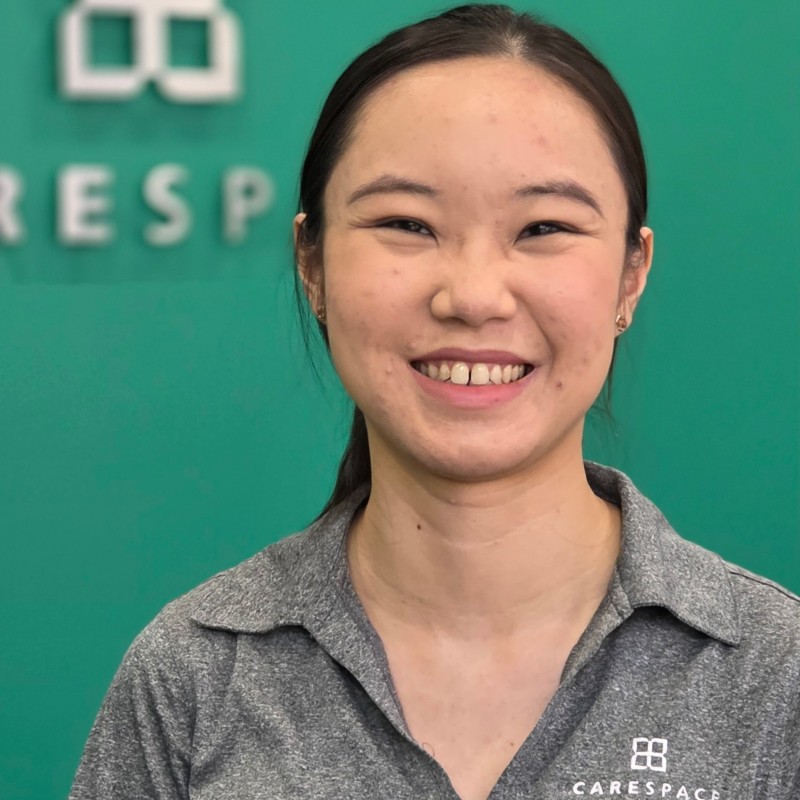
When what you’re carrying has become too much to manage alone, Leah gives you a calm place to begin again
If you’re living with anxiety, depression, social isolation, trauma, addiction patterns, disordered eating, self-harm urges, or a life transition that has shaken your sense of who you are, you may not need someone to rush you toward quick answers. You may need someone who can sit with the whole story, notice the patterns beneath it, and help you take one grounded step at a time. Xinhe (Leah) Liu, BA (Hons), MA, RP(Q), is a Registered Psychotherapist (Qualifying) at CARESPACE Deer Ridge who brings psychology, spiritual care, research training, crisis support experience, and lived cross-cultural sensitivity into warm, collaborative therapy. Through
counselling in Kitchener, Leah offers a space that is conversational and flexible without feeling aimless. She helps you identify recurring themes, understand how old wounds still shape present choices, and build practical ways to feel safer, steadier, and more connected in your day-to-day life. You set the pace; Leah helps you make the path visible.
Leah brings gentle curiosity, research-minded care, and identity-affirming insight to your therapy
Leah Liu, BA (Hons), MA, RP(Q), provides comprehensive psychotherapy for a wide range of mental health concerns, including anxiety, depression, stress, interpersonal challenges, identity questions, trauma, loneliness, and major life changes. What makes Leah’s perspective especially distinctive is the way she draws insights from psychological research, spiritual care, and identity-affirming presence. Her background as a first-generation immigrant from China, her ability to offer therapy in Mandarin and English, and her experience supporting university students, LGBTQ+ communities, new immigrants, and Chinese communities help her recognize the pressures that can be hard to explain when culture, family, language, belonging, and expectation are all intertwined. Leah brings particular depth to addiction, eating disorders, and self-harm/NSSI. That depth matters because these concerns often carry shame; Leah’s style helps you approach them with safety, honesty, and compassion, rather than fear or judgment.
Your sessions with Leah feel like a careful conversation, not a script you have to fit into
When you meet with Leah, you can expect therapy that is unstructured enough to feel approachable and intentional enough to help you move forward. She listens for what is happening now, what has happened before, and what your mind, body, relationships, culture, and values may be trying to tell you. Together, you can identify therapeutic themes, refine goals, and choose steps that feel realistic rather than overwhelming. Her work draws from CBT and DBT, solution-focused therapy, narrative therapy, psychodynamic therapy, family systems theory, and art therapy, which means the approach can adapt to what you need instead of forcing your story into one method. Her work also sits within CARESPACE’s broader
counselling service, where person-focused, evidence-informed mental health care can be coordinated with other disciplines when your goals call for whole-person support. At
CARESPACE Deer Ridge Kitchener, your emotional health can be considered alongside sleep, movement, nutrition, physical stress, and daily routines.
Her training gives your story both emotional depth and careful clinical structure
Leah’s Master of Arts in Spiritual Care and Psychotherapy from Martin Luther University College at Wilfrid Laurier University gives her a framework for understanding suffering, meaning, and healing without reducing your life to symptoms. Her Bachelor of Arts in Honours Psychology, Research-Intensive Specialization, and Honours Arts and Business Co-op from the University of Waterloo give her a research-minded foundation for noticing patterns, testing assumptions, and grounding care in careful thought. During her internship at the Delton Glebe Counselling Centre, Leah worked with a diverse population of young adults across varying treatment durations, ranging from single-session work to longer-term therapy extending beyond 20 sessions. Her Applied Suicide Intervention Skills Training, crisis response experience with Kids Help Phone, and Mandarin Helpline volunteer supervision sharpened her active listening and risk assessment skills, so difficult subjects can be handled with steadiness, clarity, and respect.
If addiction, disordered eating, or self-harm has become the language your pain speaks, Leah helps you build a safer one
While Leah’s psychotherapy practice remains broad, her specialty depth is especially valuable if your struggle has become tangled with urges, shame, secrecy, or control. Addiction work with Leah is not framed as a character flaw. Together, you can look at what the pattern does for you — how it numbs, soothes, distracts, gives relief, or protects you from pain — while also noticing what it costs in your body, relationships, goals, and sense of self. Drawing from CBT/DBT, mindfulness, motivational interviewing, and a harm reduction principle, Leah helps you identify triggers, expand the pause between urge and action, and build small, realistic alternatives that can survive real life.
Eating disorder support with Leah begins from the same nonjudgmental stance. If food, body image, exercise, restriction, bingeing, purging, or control has become a way to manage fear, perfectionism, loneliness, or trauma, Leah helps you slow down the story underneath the behaviour. Her narrative, psychodynamic, family-systems, and spiritual-care lenses allow room for cultural messages, family expectations, identity, grief, and meaning — the deeper context that often gets missed when the focus stays only on symptoms.
For self-harm and non-suicidal self-injury, Leah brings calm risk assessment, crisis support training, and deep respect for how overwhelming emotions can feel when you have had to manage them alone. The work is not about shock, punishment, or shame. It is about safety, understanding, and gradually developing other ways to communicate pain, regulate your nervous system, and stay connected to yourself during distress. If trauma, depression, anxiety, or social isolation sits underneath these concerns, Leah helps you work at the right depth: practical skills when you need stabilization, reflective exploration when you are ready for meaning, and creative tools such as mindfulness, art, or music, when words are not enough.
Outside the therapy room, Leah’s curiosity shows up in cats, coffee, nature, stories, and creative discovery
Leah’s warmth is grounded in more than professional technique. Outside the therapy room, she loves cats, coffee, nature, and stories, and she enjoys developing new hobbies that nurture a curious mind. That curiosity shows up in the way she listens: gently, closely, and with genuine interest in the meanings you carry. Rather than forcing your experience into a template, Leah is inclined to wonder with you, make space for complexity, and notice the small details that may become doors into change.
The next step is simple: book with Leah before another week becomes another cycle
Book with Leah Liu today and begin building a steadier, safer, more connected way to move through what has felt too heavy to carry alone.